The Leadership Lab: Mastering Difficult Conversations
- Role
Product strategy, learning architecture, UX/UI, creative direction and interaction design. Implementation developed with Codex. Maya’s original portrait was generated; dialogue, state rules and expression animation are authored.
- Duration
November 2026 · Iterative product build
- Tools
React, TypeScript, Vite, SVG/CSS animation, IndexedDB, browser speech synthesis, Playwright and Vitest. No paid avatar service or runtime model API.

Motion Defines Hierarchy
Hero Choreography
Album Card Motion System
System at rest

Contextual Depth & Focus Priority
predictive path & system awareness
Motion System Breakdown
Reel




1
Build Overview


2
Creative Rationale
Goal
Create a private, replayable space for practicing empathy, clarity and accountability. Make feedback specific enough to inspect, consequences visible enough to discuss, and the next action concrete enough to take into a real conversation.
Process
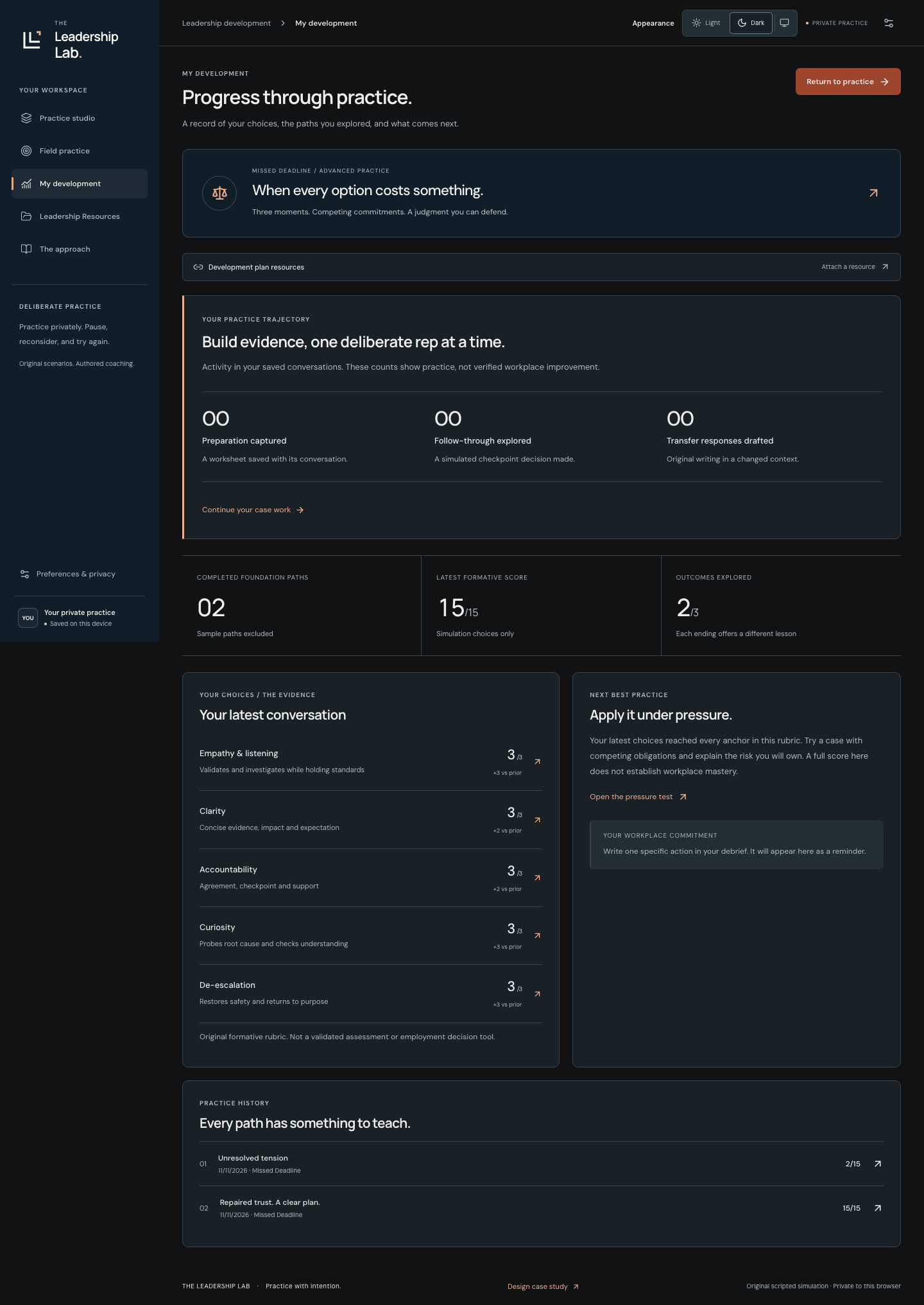
I translated the brief and source themes into five observable behavior goals, then mapped decisions, emotional states and endings before building the interface.
I authored dialogue and scoring rules together so each coaching point could be traced to a specific response. Replays and comparisons made the consequences inspectable, while an advanced pressure test introduced competing obligations.
I refined the early visual direction into an editorial enterprise interface, then checked every foundation and advanced choice sequence, local storage, exports, keyboard controls and responsive themes. The next phase is moderated learner research and revision based on observed use.
Key Highlights
Detailed Insights
Deep Dives
Learning Science
The architecture connects practice, observable consequences, feedback and another attempt. Public leadership-development research and de-identified meeting-archive themes provided design context; scenarios and behavior anchors are original.
The project does not reproduce Korn Ferry materials or assessment instruments and is not commissioned or endorsed by a research provider or employer. A learner study has not yet established effectiveness or workplace transfer.
2
Creative Rationale
Goal
Challenges
Process
Impact and Results
Measurable Outcomes
Takeaways
1
The brief
Goal
Create a private, replayable space for practicing empathy, clarity and accountability. Make feedback specific enough to inspect, consequences visible enough to discuss, and the next action concrete enough to take into a real conversation.
Challenges
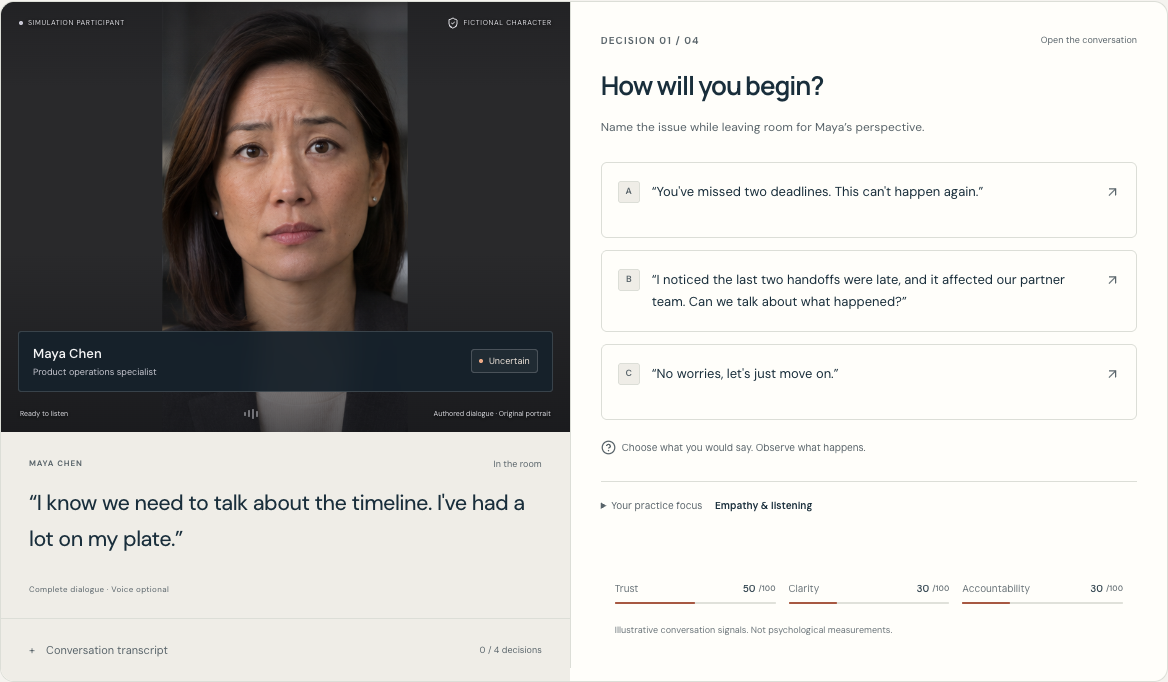
- Make Maya feel like a professional colleague using free browser technologies.
- Keep branching dialogue and feedback coherent across cumulative choices and three endings.
- Move beyond obvious preferred answers without inventing a universal score for judgment.
- Protect local documents and saved work while making replay, comparison and export reliable.
Learning Objectives
Intended practice outcomes:
- Separate observable behavior from assumptions about motive.
- Ask about constraints before prescribing a solution.
- Acknowledge tension while maintaining a clear standard.
- Agree on an owner, action, checkpoint and escalation route.
- Explain what a decision protects, who carries its cost and what must be verified.
These are design intentions, not measured learner-effectiveness findings.
Learning Science
The architecture connects practice, observable consequences, feedback and another attempt. Public leadership-development research and de-identified meeting-archive themes provided design context; scenarios and behavior anchors are original.
The project does not reproduce Korn Ferry materials or assessment instruments and is not commissioned or endorsed by a research provider or employer. A learner study has not yet established effectiveness or workplace transfer.
Learning Methodolgy
Prepare: inspect evidence and draft an opening. Practice: make four consequential decisions and explore contextual follow-up questions. Reconsider: rewind a moment and compare paths. Transfer: work through a follow-up and changed constraint, then export a specific commitment.
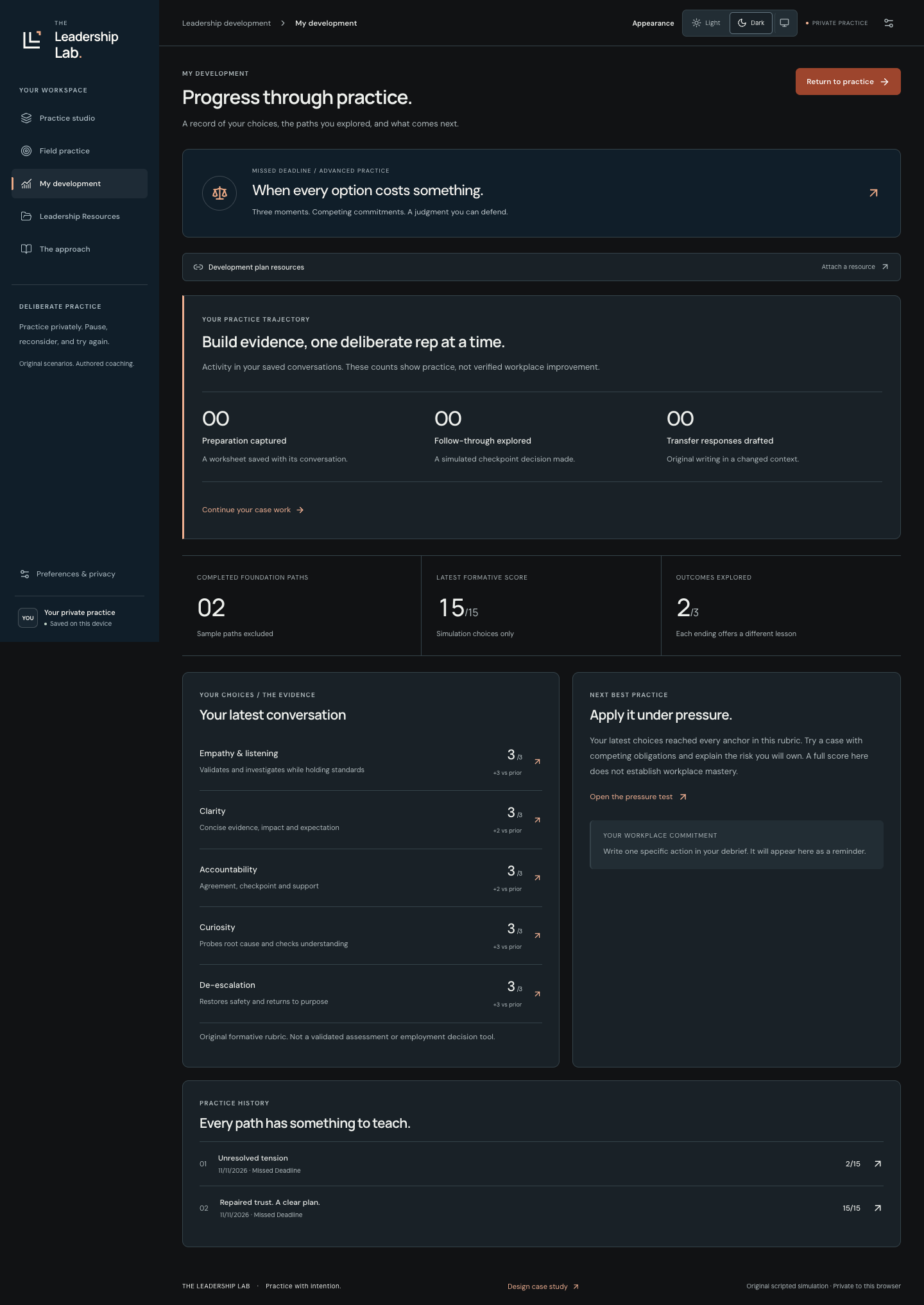
An advanced pressure test adds competing obligations. Every response protects something while creating a risk; learners can explain their reasoning instead of identifying one ideal phrase.
Process
I translated the brief and source themes into five observable behavior goals, then mapped decisions, emotional states and endings before building the interface.
I authored dialogue and scoring rules together so each coaching point could be traced to a specific response. Replays and comparisons made the consequences inspectable, while an advanced pressure test introduced competing obligations.
I refined the early visual direction into an editorial enterprise interface, then checked every foundation and advanced choice sequence, local storage, exports, keyboard controls and responsive themes. The next phase is moderated learner research and revision based on observed use.
Impact and Results
Built to practice. Designed to prove.
A working leadership simulation with an original professional character, inspectable coaching and a complete loop from preparation to replay and a personal next step. The foundation scenario and advanced pressure test use authored dialogue and rules, with no paid avatar services or runtime generative AI API.
Take the practice into the next conversation.
Four original toolkits provide eight downloadable files. The local document library supports PDF, DOCX, TXT and Markdown references, with scenario, coaching-session and development-plan associations. Documents remain on the device and do not influence authored coaching.
Measurable Outcomes
65 Chrome browser checks passed. 135 unit checks passed.
81 foundation choice sequences verified across four decisions and three endings. 27 advanced sequences verified across three pressure moments.
Implementation verification recorded November 11, 2026. Choice sequences converge through shared scenes; these are not unique scripts. Figures describe scope and testing, not measured learner improvement. Development screenshots use illustrative scripted test data.
The linked working application is currently an owner-private preview. Reviewer access must be configured before a public demo launch.
Takeaways
- Feedback earns trust when learners can trace it to their actual words.
- A clear action plan can coexist with unrepaired trust; the character needs emotional continuity.
- Advanced practice needs defensible competing choices and visible obligations, not only more answer options.
- Local ownership and useful exports make reflection portable.
Next: run the prepared moderated learner-study protocol, observe interpretation and hesitation, revise the experience, and test application to an unfamiliar constraint.
Accessibility & inclusion
Complete text works without voice. Keyboard controls, explicit labels, focus restoration, light/dark/device themes, reduced motion and responsive layouts are implemented. Automated accessibility scans passed across tested flows and widths from 360 to 1440 pixels.
This is not an independent accessibility certification. Screen-reader and broader browser validation remain part of the next research phase.





65 Chrome browser checks passed
81 foundation choice sequences verified

135 unit checks passed
27 advanced choice sequences verified