ATLAS Voice, Enterprise AI Voice Design System
- Role
UX design systems architecture and interaction design
- Duration
- Tools
Figma · Documentation and validation
Motion Defines Hierarchy
Hero Choreography
Album Card Motion System
System at rest
Contextual Depth & Focus Priority
predictive path & system awareness
Motion System Breakdown
Reel






1
Build Overview



2
Creative Rationale
Goal
Process
Key Highlights
Detailed Insights
Deep Dives
Learning Science
2
Creative Rationale
Goal
Challenges
Process
Impact and Results
Measurable Outcomes
Takeaways
1
The brief
Goal
Challenges
Learning Objectives
Learning Science
Learning Methodolgy
Process
Impact and Results
Measurable Outcomes
Takeaways
Accessibility & inclusion

3
Results
Atlas Voice


Atlas Voice






Atlas Voice
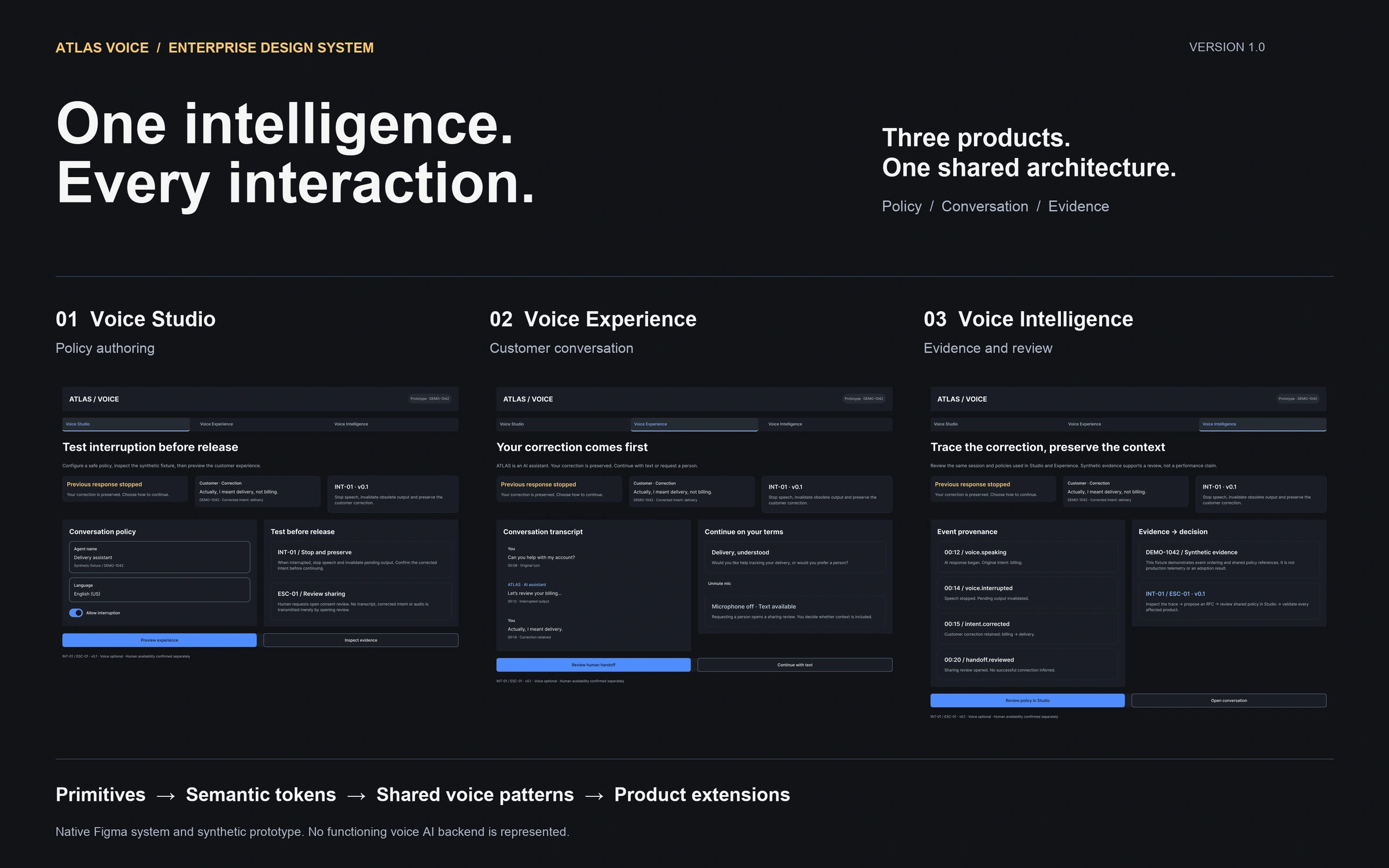
ATLAS Voice is a shared design architecture for configuring, experiencing and understanding enterprise AI voice. It connects Voice Studio, Voice Experience and Voice Intelligence through reusable components, semantic tokens and explicit recovery rules.
- Interruption
- Correction
- Consent review
- Recovery
One intelligence. Every interaction.
- Role
UX design systems architecture and interaction design
- Tools
Figma · Documentation and validation
One intelligence. Every interaction.
ATLAS is a self directed enterprise design systems case study and design simulation. The deliverable is a native Figma system and synthetic interaction prototype. It does not represent a deployed AI service, an enterprise client engagement or measured business impact.
02 A system for the entire conversation
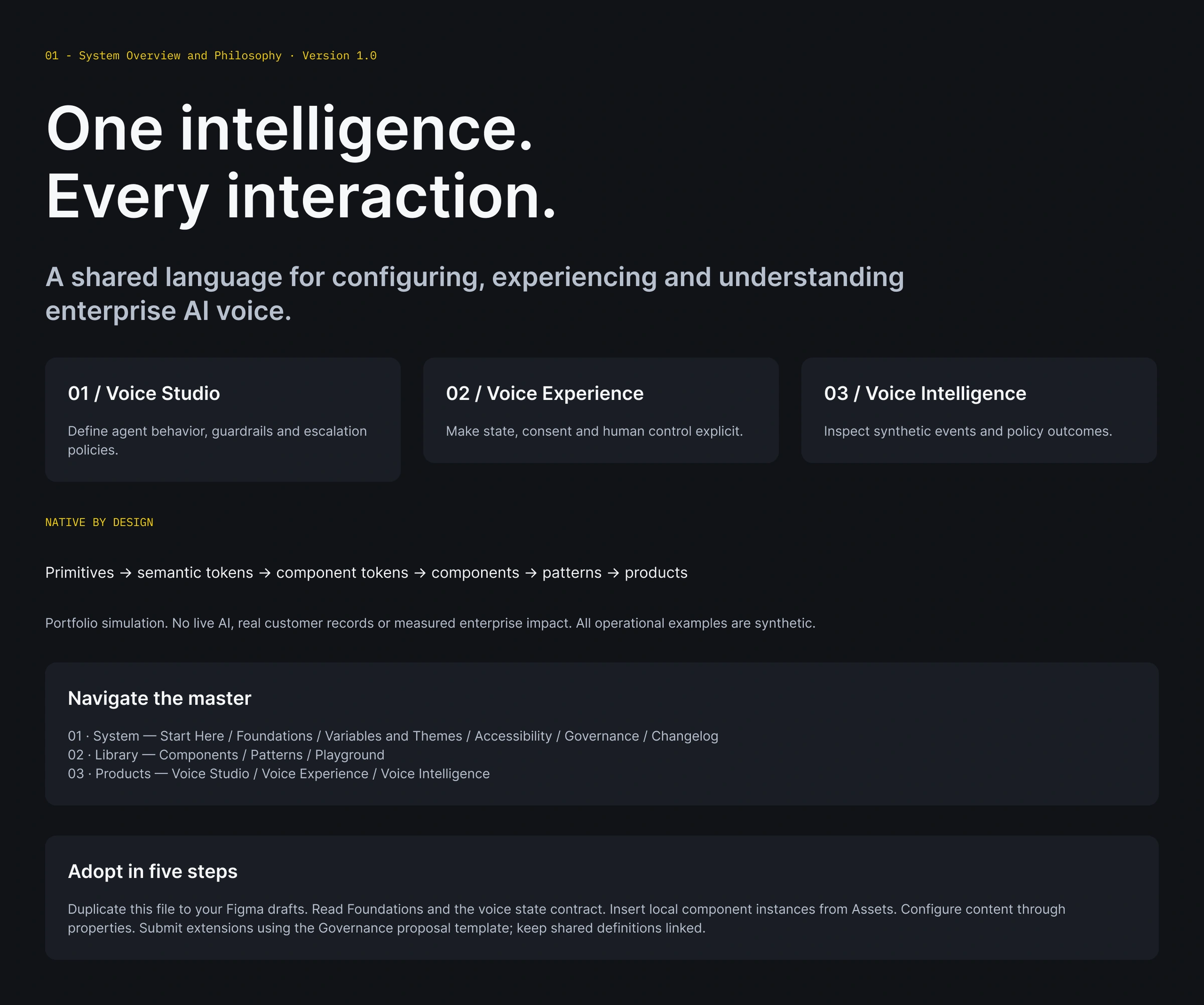
A conversation crosses several responsibilities: a team configures an agent, a customer corrects its response, and an operator reviews what happened. When each product defines its own states, consent language and recovery behavior, that event becomes harder to understand and maintain.
I treated continuity as the architectural problem. The system had to preserve the meaning of an interruption, a correction and a sharing decision across three different workflows. Visual consistency mattered because it reinforced that contract, but the contract came first.
The North Star of one intelligence, every interaction became a decision rule: product teams could vary workflow and information density while preserving AI disclosure, user control, state meaning and accessible alternatives.
Open full resolution north star image
03 Shared architecture, deliberate boundaries
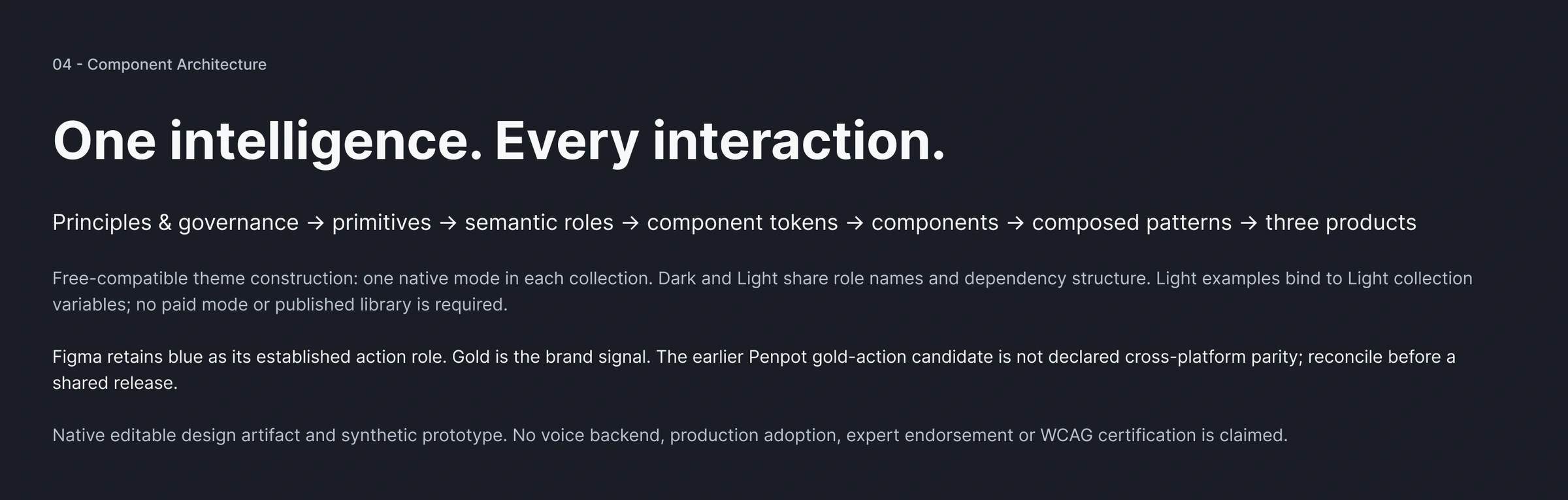
I separated primitives, semantic roles, component tokens, native components, composed patterns and product extensions. Each layer has a different responsibility: a primitive defines a raw value; a semantic token explains its purpose; a component contract defines how that purpose appears and behaves.
The same recovery pattern appears in policy configuration, the customer conversation and operational review. Product specific content can change without redefining what correction or consent means. This reduces the number of independent decisions that would otherwise drift across products.
The boundary is intentional. Workflow content, domain policy and density may extend locally. Consent, AI identity, state semantics, human handoff and non voice alternatives remain shared. ATLAS demonstrates this architecture in a local Figma master; it does not claim enterprise library adoption or complete code parity.
Open full resolution system architecture image
04 Tokens express intent before appearance
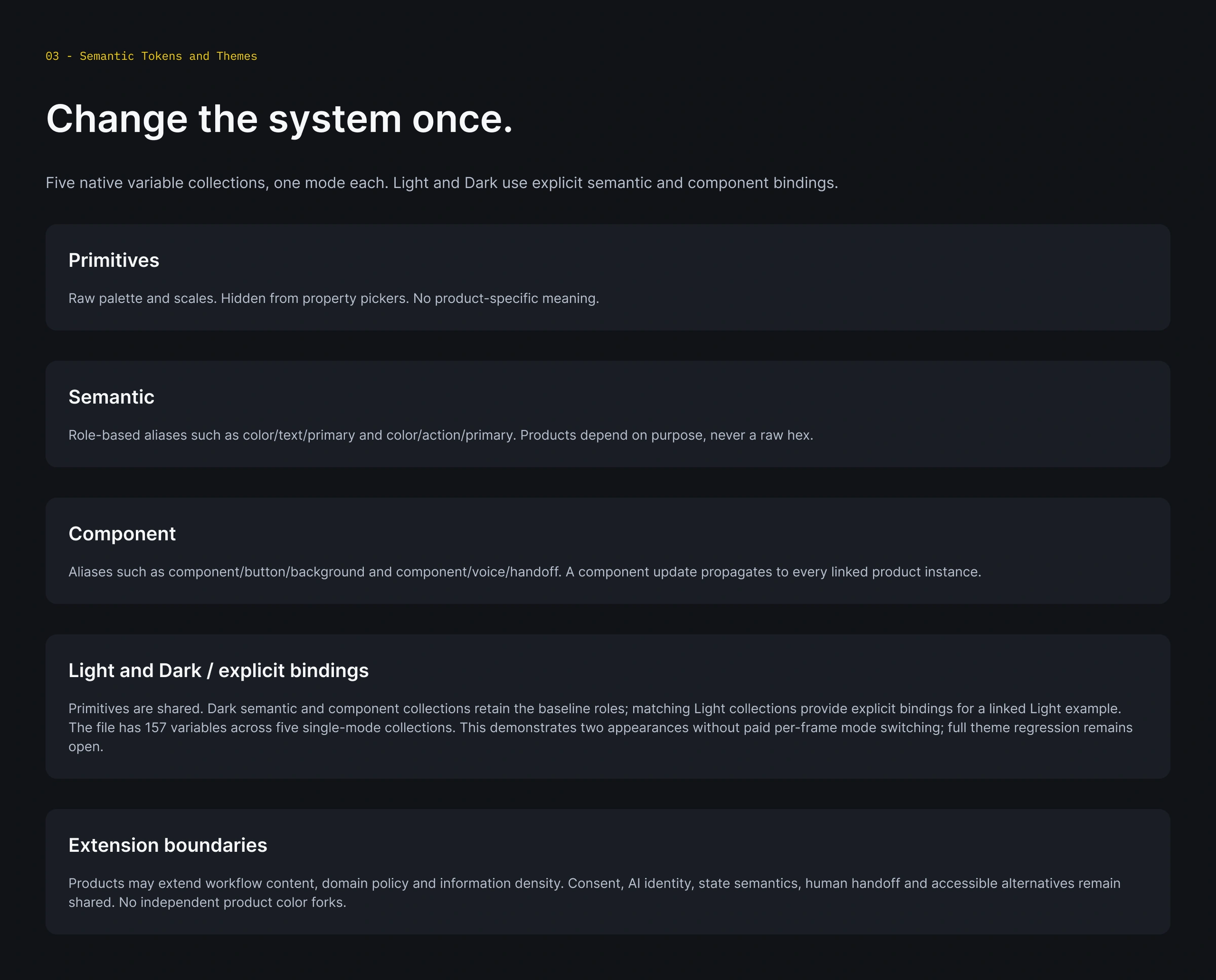
I used semantic naming to make design decisions understandable beyond a particular screen. Text, surfaces, actions and status roles resolve through shared primitives rather than independent product palettes. Component level aliases provide a smaller surface for controlled changes.
The implemented file contains 157 variables across five single mode collections: Primitives, Semantic, Component, Semantic Light and Component Light. Light and Dark use explicit bindings, including a linked Light conversation example. This is a Free compatible construction approach, not paid per frame mode switching or evidence of complete theme regression.
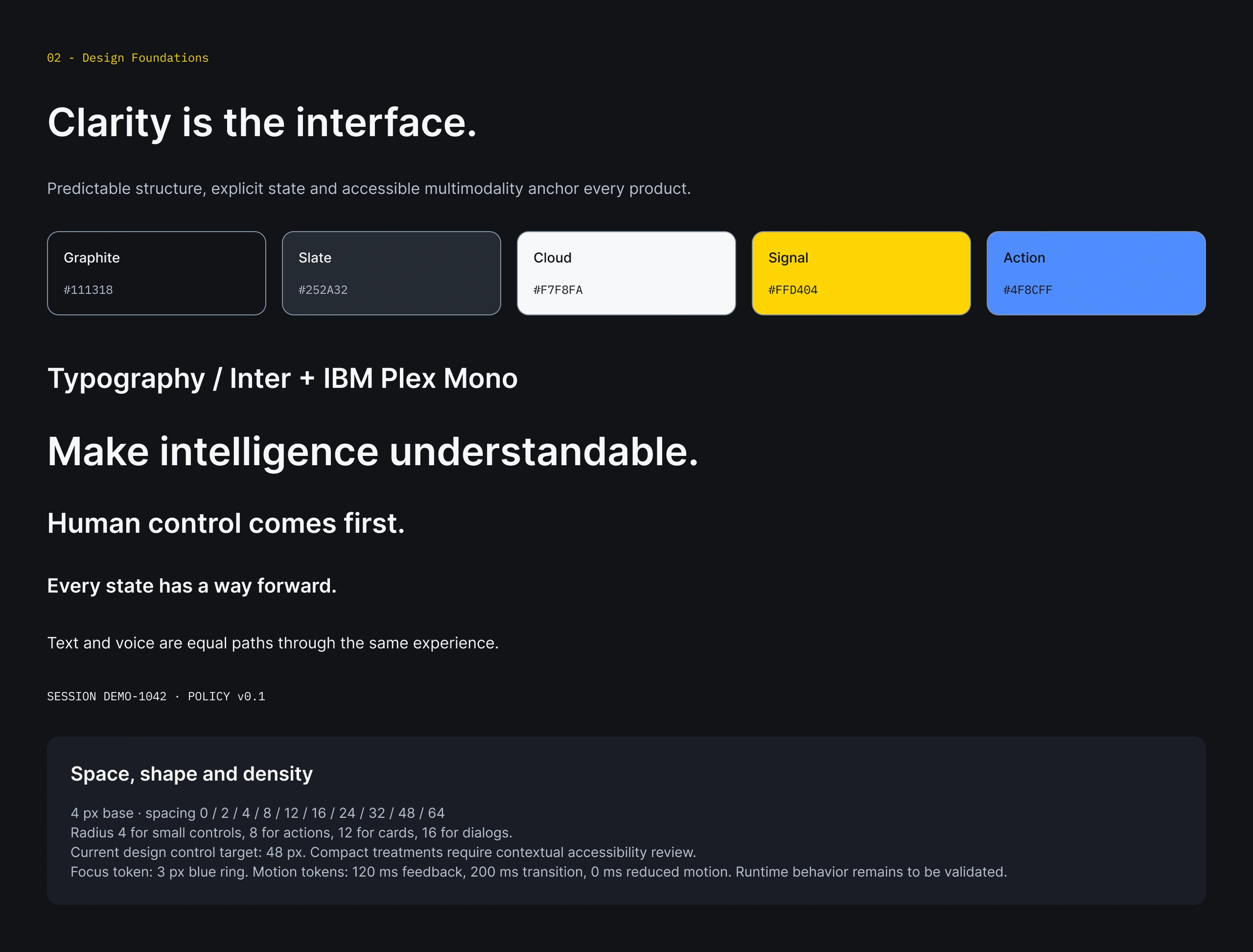
Foundations use a 4 px spacing base, a current 48 px control target and a 3 px focus token. Motion tokens distinguish 120 ms feedback, 200 ms transitions and a 0 ms reduced motion value. These are design specifications; runtime focus and motion behavior still require implementation testing.
Open full resolution token architecture image
Open full resolution design foundations image
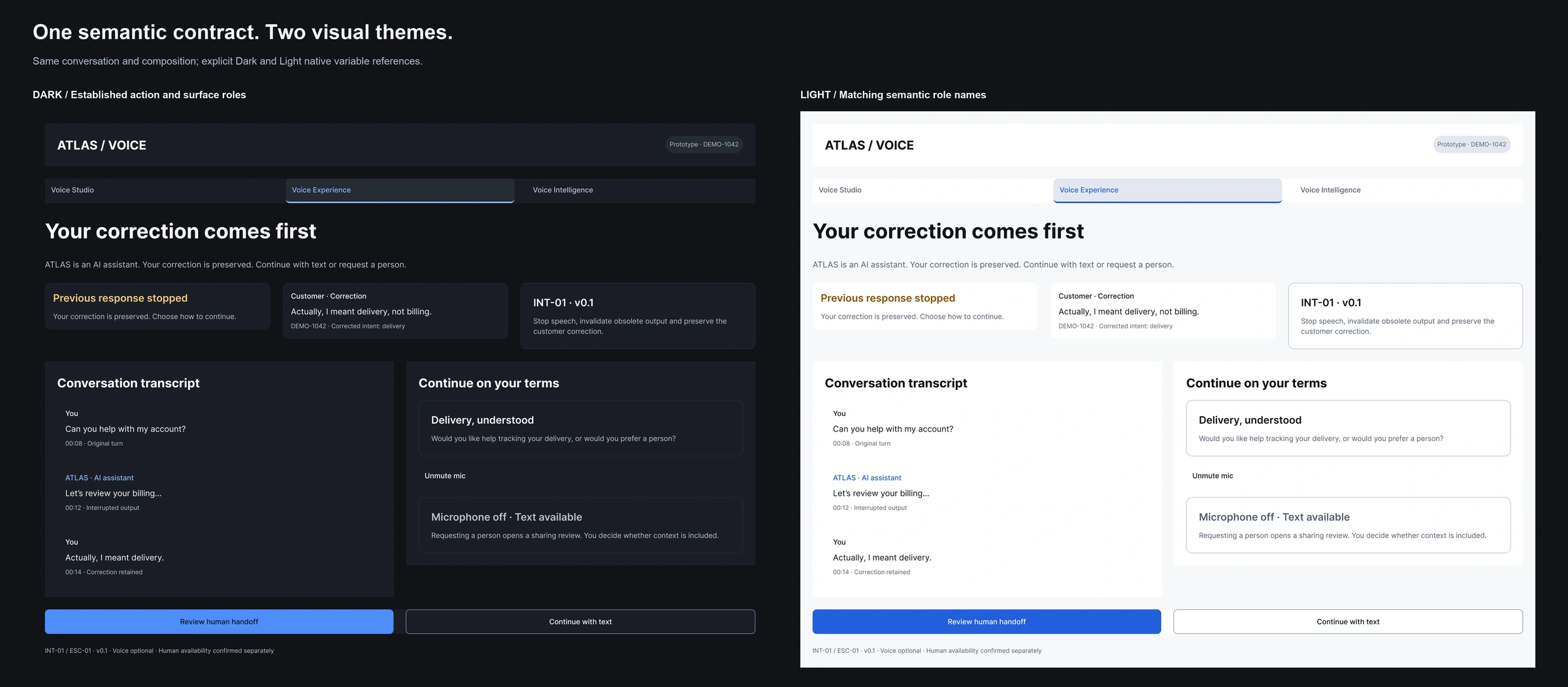
Open full resolution light dark themes image
05 Components designed to remain connected
I prioritized components that explain the system’s behavior: actions, navigation, status, transcripts, voice controls, consent and recovery. Native variants express meaningful states, while text properties support contextual content without routinely detaching instances.
The button set demonstrates two styles across Default, Hover, Pressed, Focus and Disabled states. Voice patterns compose controls, transcript content, status and recovery actions rather than reproducing those elements inside each product.
This is a deliberately selective library. Reuse is useful only when the component preserves a stable contract and allows the product variation it needs. A visual variant alone does not establish keyboard behavior, and a native Figma instance does not establish a production component implementation.
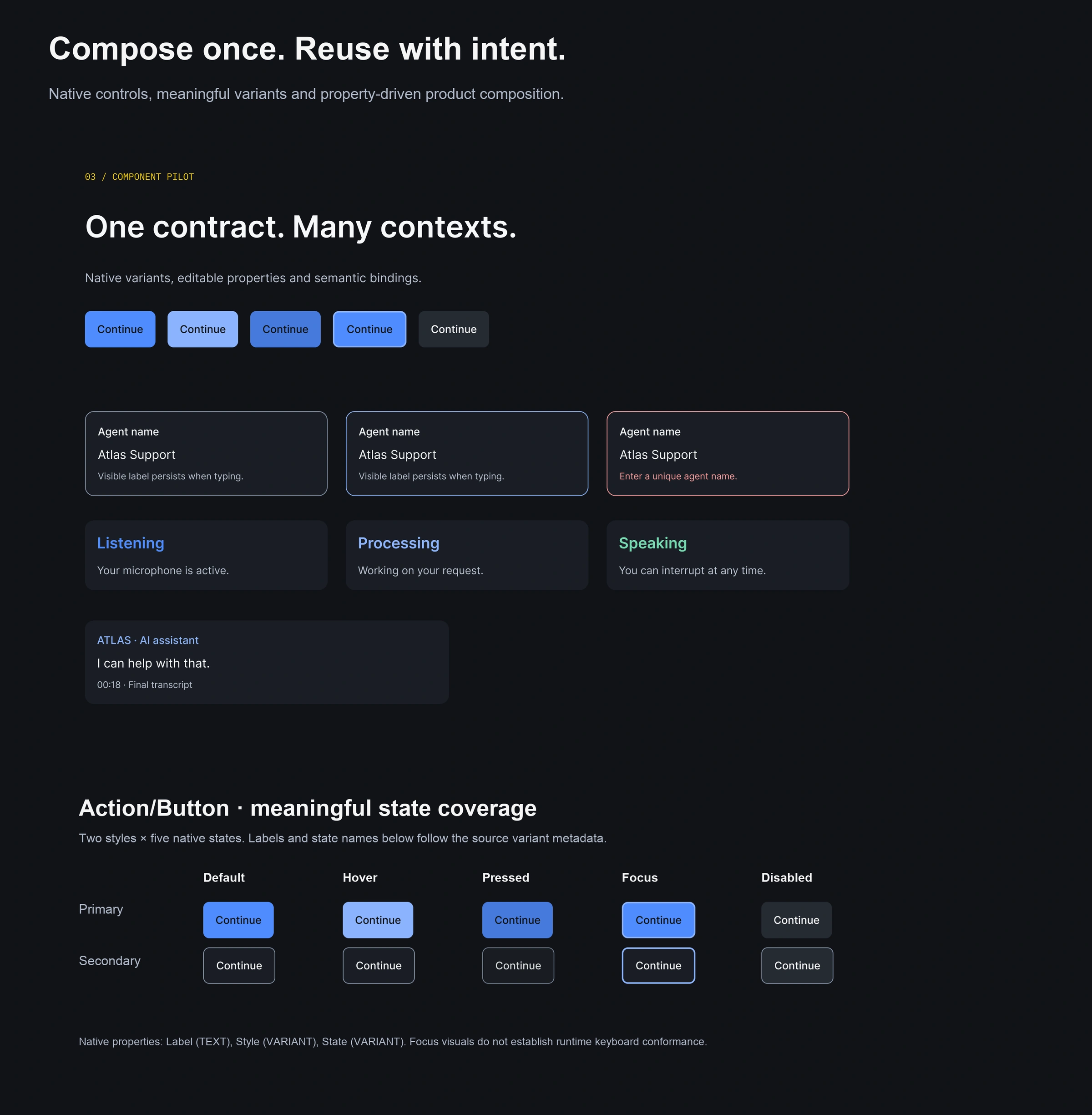
Open full resolution component engineering image
06 Recovery is part of the voice interaction model
A voice interface must explain what it is doing and what the user can do next. ATLAS defines listening, processing, speaking, interruption and recovery as explicit states. Text remains an equal route through the experience.
The central journey begins with a correction: “Actually, I meant delivery, not billing.” The prior response stops, the correction remains visible, and the customer chooses whether to continue in text or review a human handoff. Opening sharing review does not imply consent. The no context route excludes transcript, corrected intent and audio from the modeled payload.
I separated requesting help, approving a sharing scope and confirming a human connection. None implies the next. A local reference model tests those boundaries, cancellation and reconnection behavior. The click prototype and tests demonstrate intended interaction rules; they do not execute speech recognition, transmit customer data or connect to a live human queue.
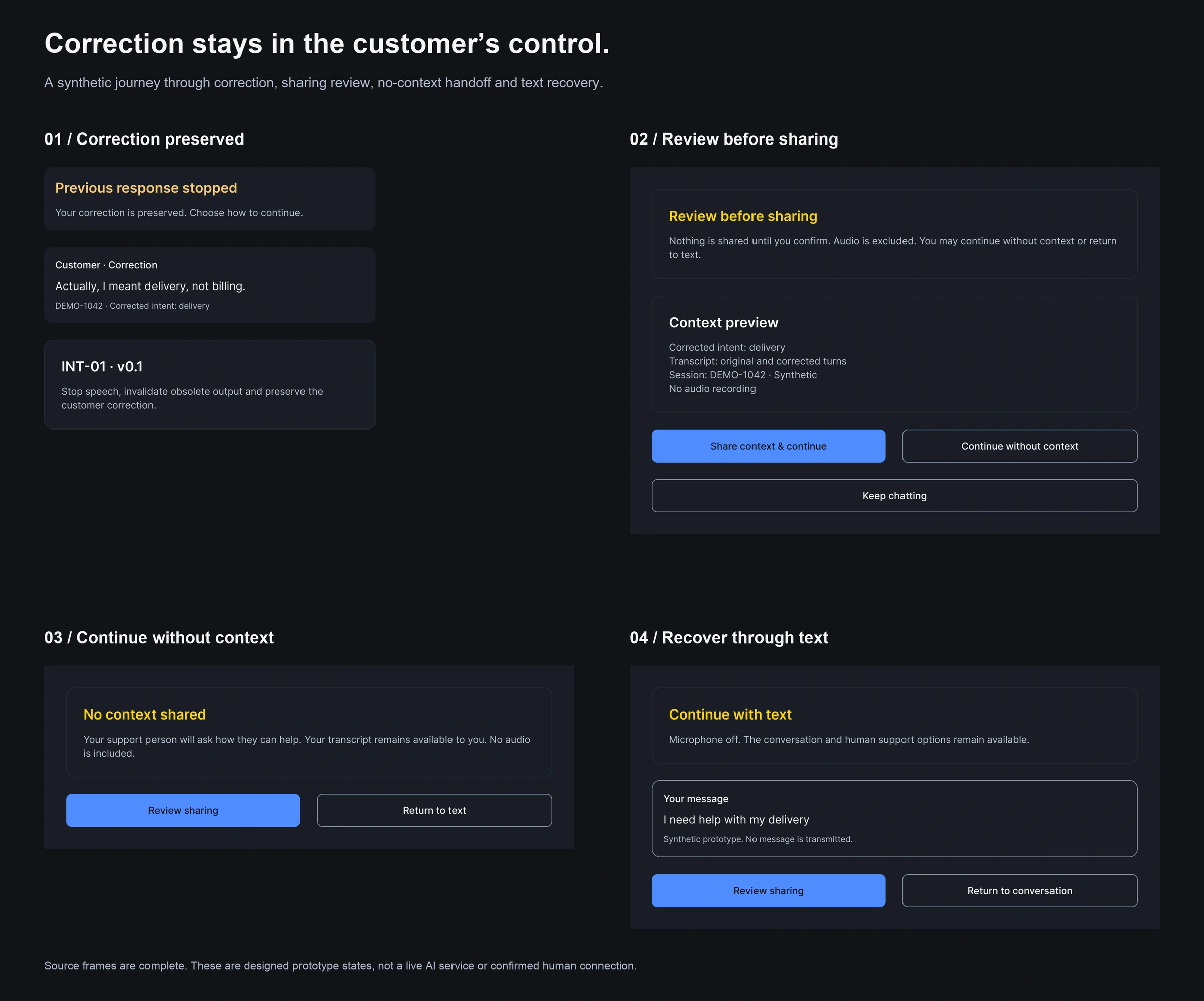
Open full resolution interruption recovery image
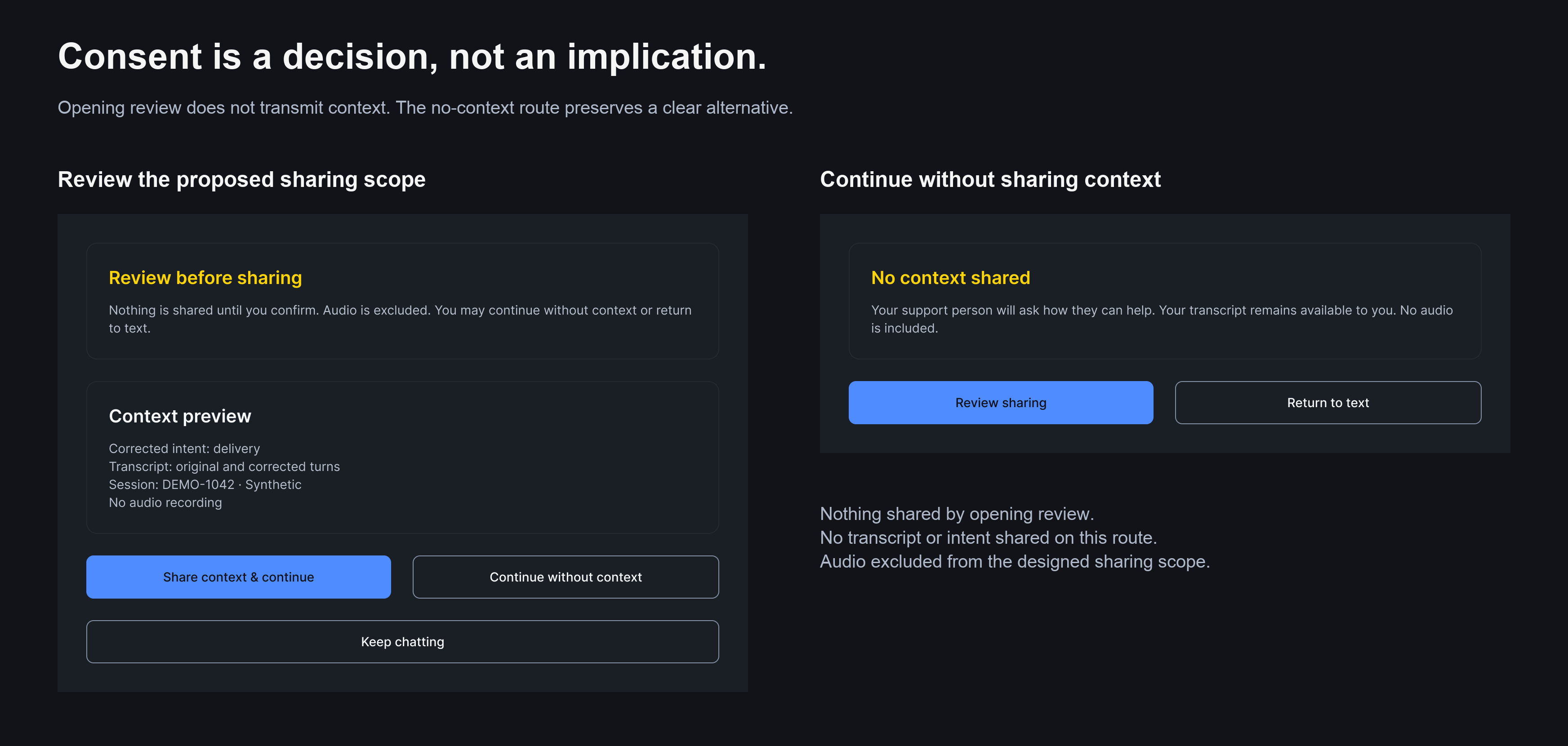
Open full resolution consent handoff image

Open full resolution voice interaction overview image
07 Voice Studio: configure the contract
Voice Studio presents the policy authoring side of the system. It connects agent behavior, guardrails, consent and escalation rules to the states customers encounter.
I used shared controls and recovery language to keep policy configuration aligned with the customer experience. The product specific extension is its authoring context and information density, rather than an independent definition of interruption or handoff.
The interface is a design simulation. Its controls do not publish a production policy or configure a functioning voice backend.
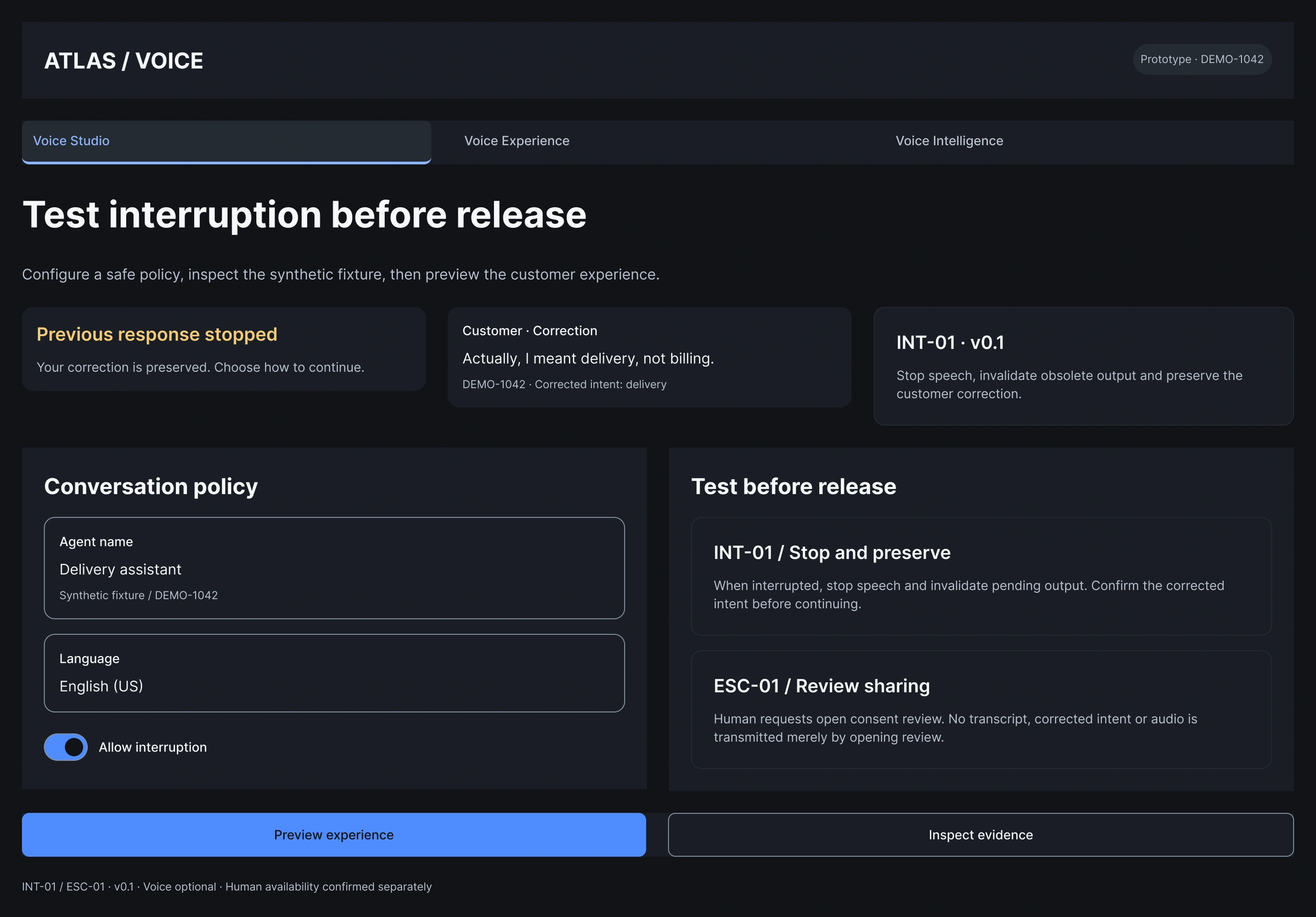
Open full resolution voice studio desktop image

Open full resolution studio mobile image
08 Voice Experience: preserve the customer’s intent
Voice Experience is the customer facing expression of the shared contract. AI identity, transcript, conversation state and recovery actions remain visible together so that a correction is understandable in context.
I made the user’s correction the dominant event. The interface records the interrupted output separately, preserves the corrected intent and offers text continuation or a deliberate sharing review. A request for a person does not become an unsupported “connected” state.
The mobile composition retains the same priorities with shorter navigation labels and a vertical reading order. This demonstrates responsive design decisions, not a recorded customer session.
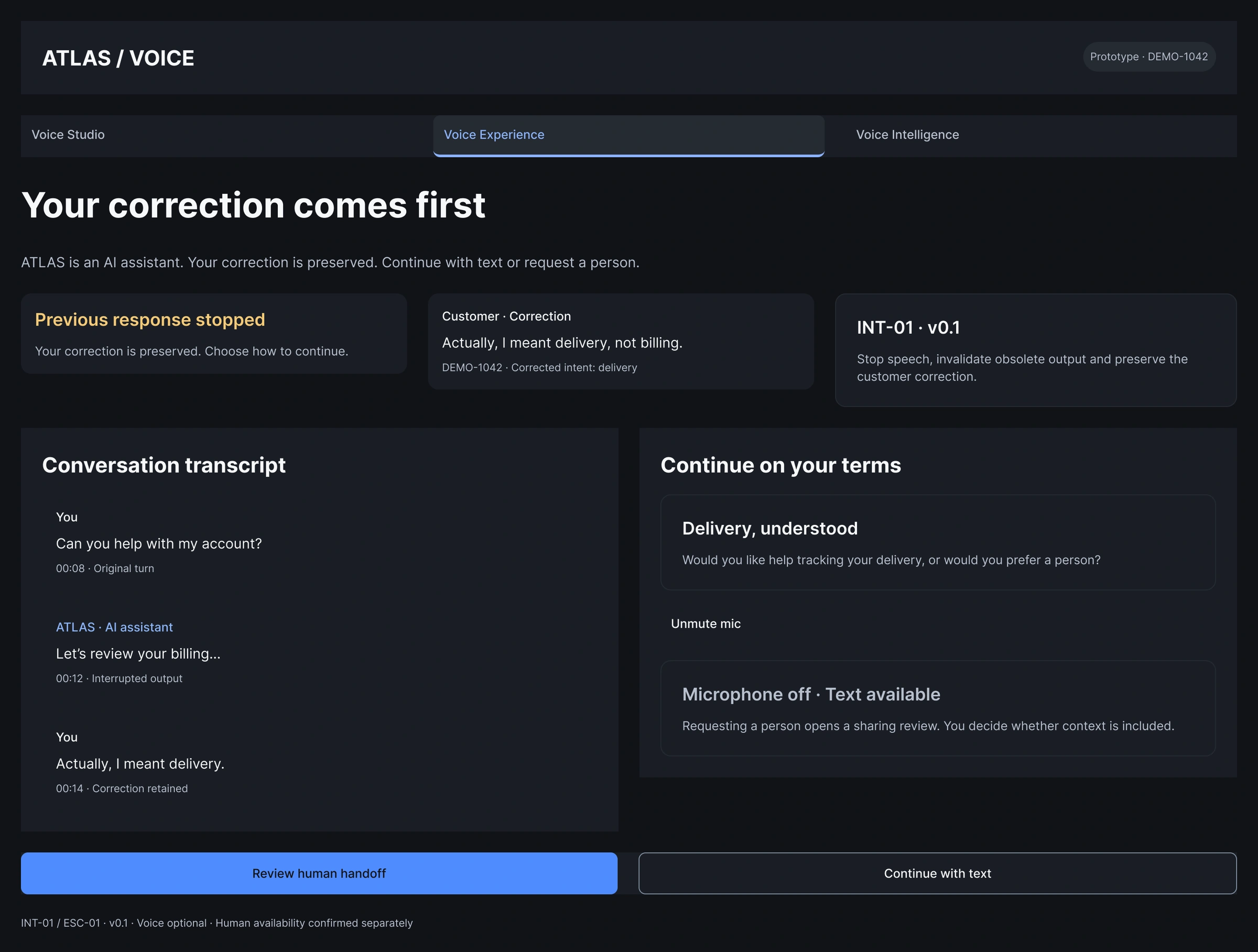
Open full resolution voice experience desktop image

Open full resolution experience mobile image
09 Voice Intelligence: make the decision inspectable
Voice Intelligence presents the review perspective: synthetic conversation events, policy outcomes and recovery evidence become inspectable in a shared vocabulary.
The design connects operational review to the same correction and consent rules used in the other products. The purpose is traceability, understanding what the interface represented, what the user chose and where confirmation is still required.
All operational records shown are synthetic. Dashboard values are interface examples, not measured service performance, enterprise adoption or evidence of production outcomes.
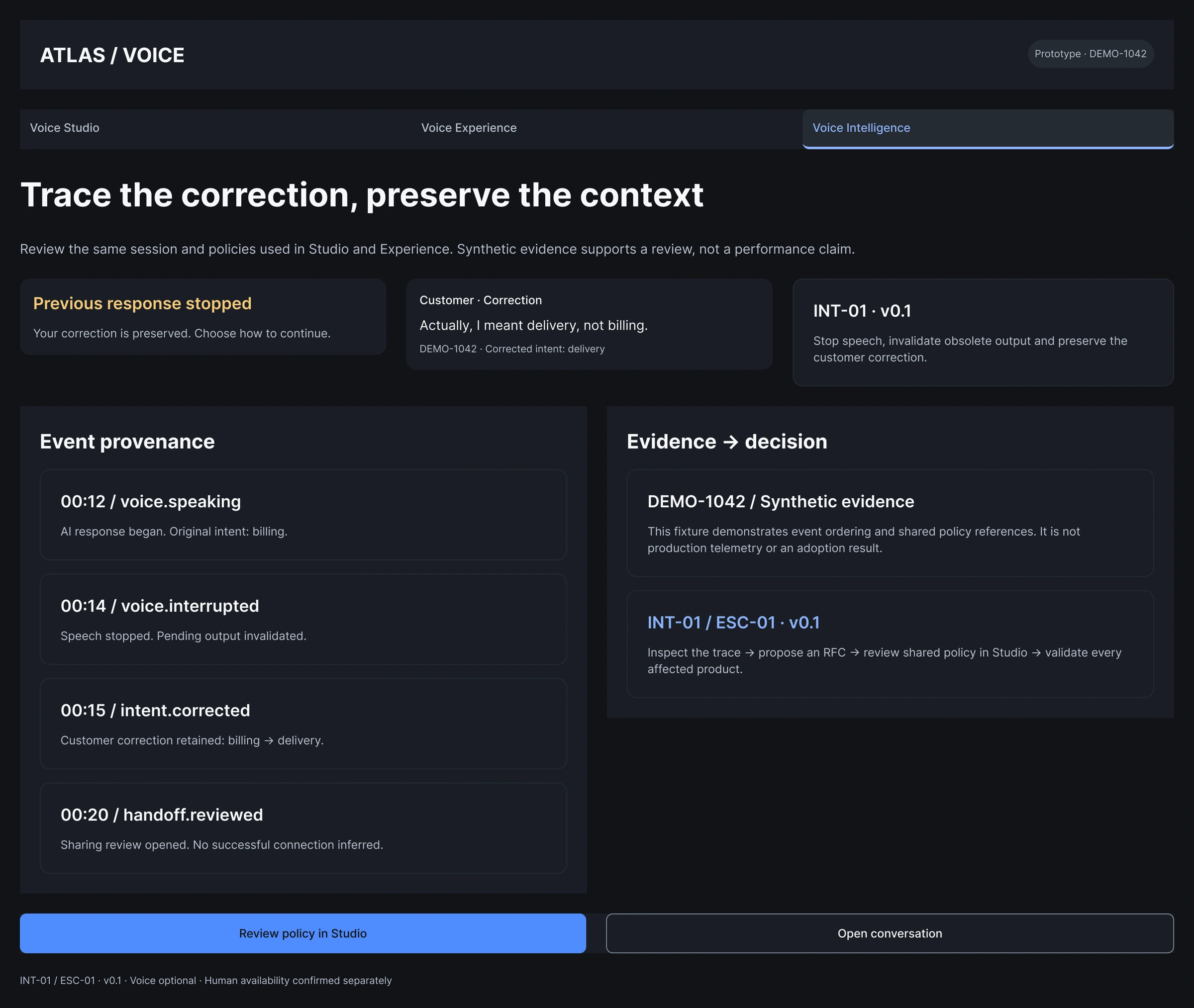
Open full resolution voice intelligence desktop image

Open full resolution intelligence mobile image
10 Responsive composition preserves the priorities
I built each product at 1440 768 and 390 px to examine how a shared system adapts to different contexts. The layouts change density and arrangement while preserving disclosure, transcript context and a visible way forward.
The comparison boards retain the complete source frames and their proportions. They show design decisions across three specified widths; they do not demonstrate a browser implementation at every intermediate breakpoint.
During export preparation I shortened the linked mobile navigation labels to Studio, Experience and Intelligence, preserving their component relationships and prototype routes. That small correction improved readability without creating a separate mobile navigation system.
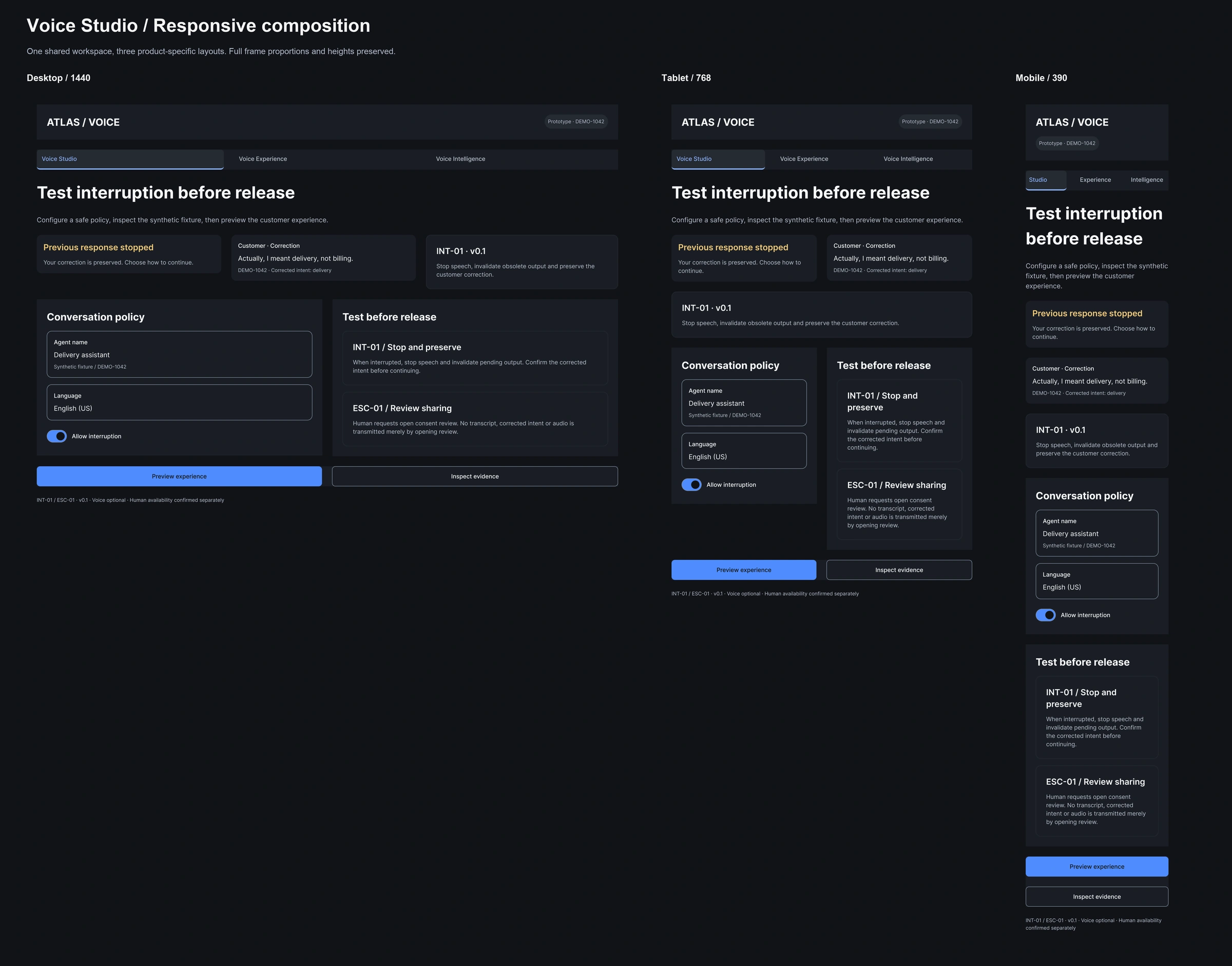
Open full resolution studio responsive image
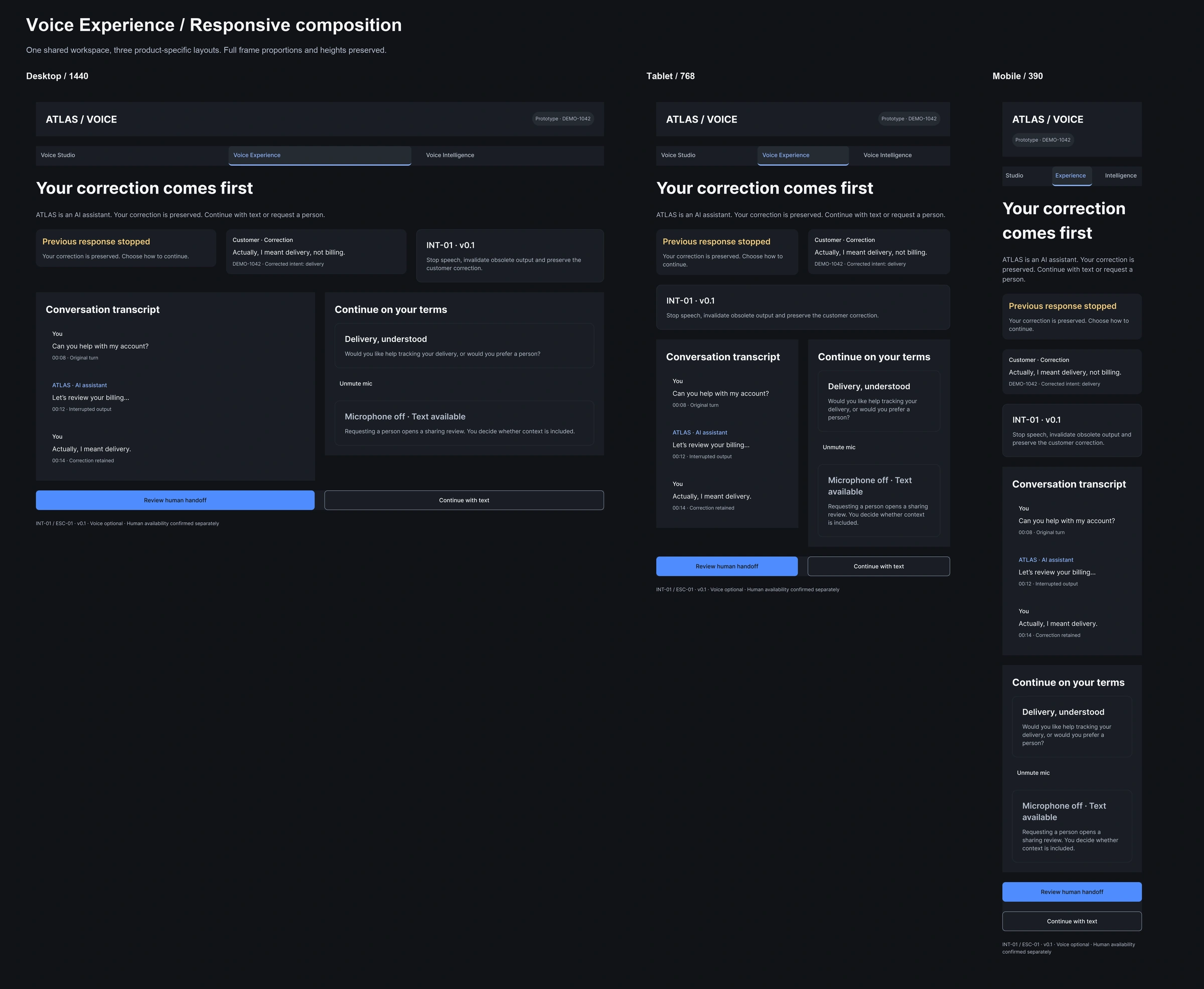
Open full resolution experience responsive image
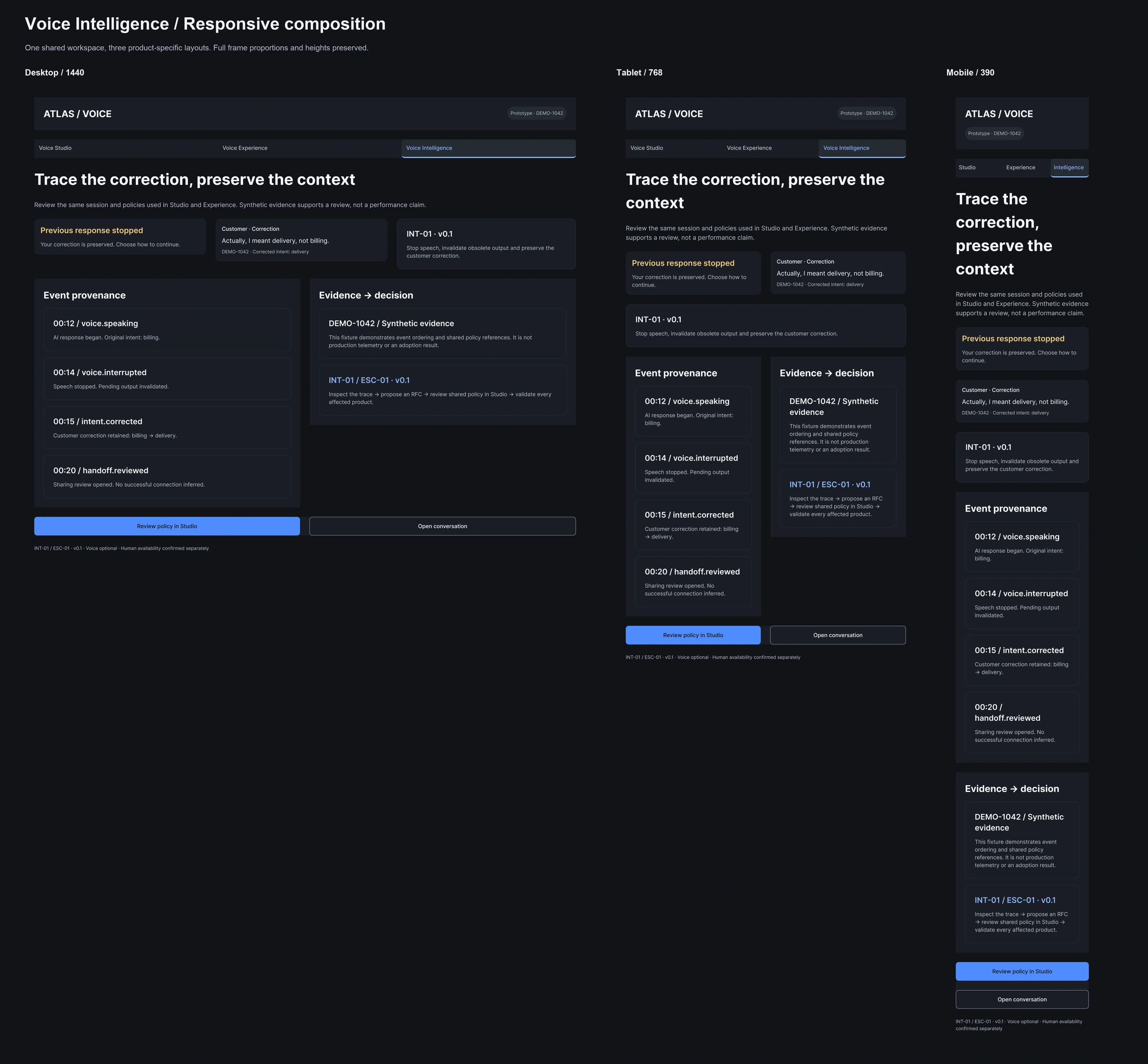
Open full resolution intelligence responsive image
11 Accessibility and governance are system responsibilities
I targeted WCAG 2.2 AA through explicit AI disclosure, text alternatives, readable state labels, focus specifications and generous controls. Consent and recovery are included in the shared patterns so that teams do not have to reconstruct them for every workflow.
The governance model proposes ownership, contribution review, component contracts and release documentation. Its purpose is to make a shared change assessable: what contract changes, which products depend on it and what evidence is needed before release. These are proposed operating practices, not evidence of an established organization using ATLAS.
Artifact checks support selected contrast and sizing decisions. Production accessibility remains open: keyboard order, screen reader announcements, live regions, speech alternatives and complete Light/Dark coverage require runtime and user evaluation. ATLAS is not accessibility certification.
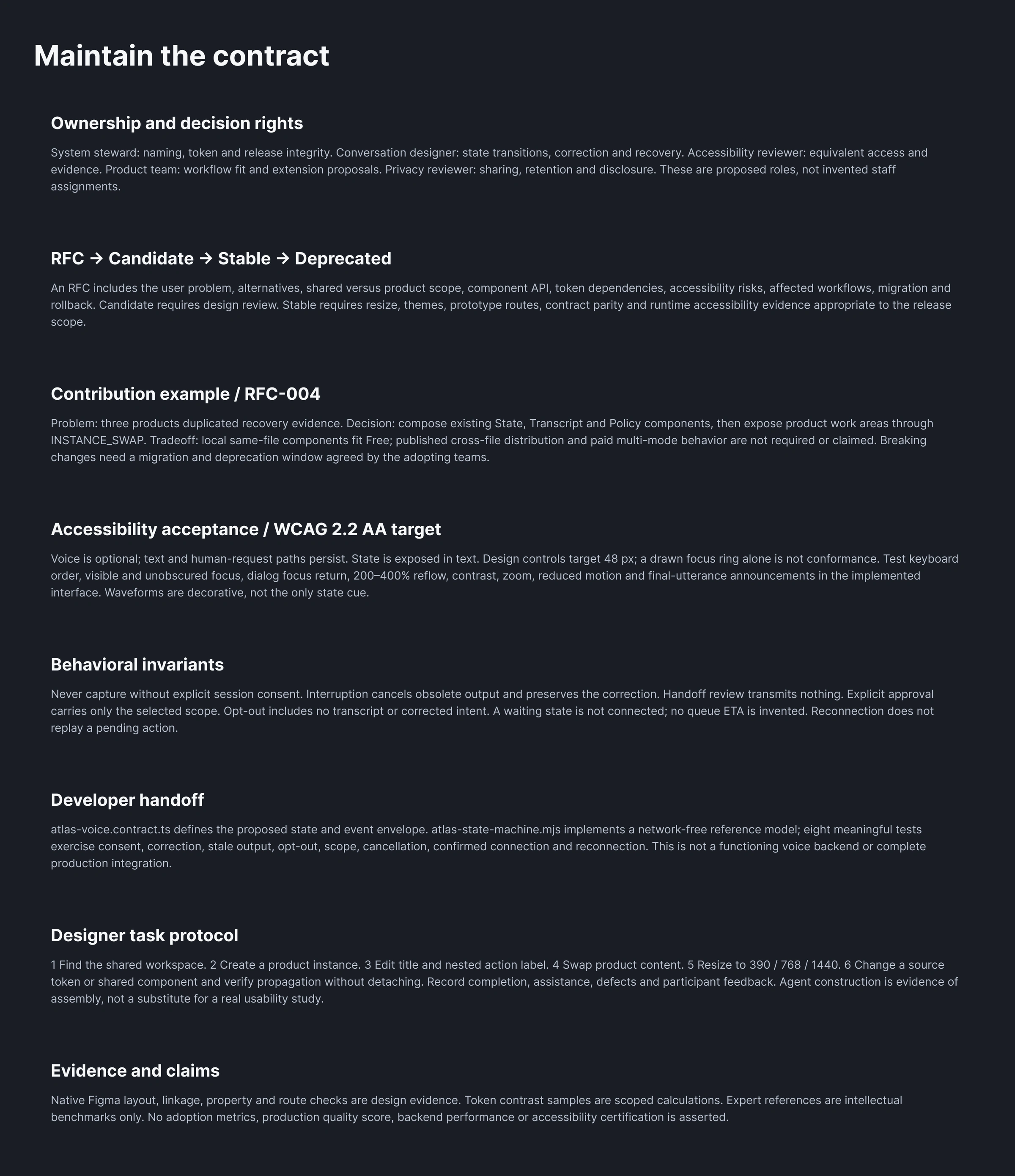
Open full resolution governance model image

Open full resolution accessibility framework image

Open full resolution component contracts image
12 Validation makes the limits visible
I used inspectable evidence to distinguish an intended system from a verified result. The local reference model currently passes eight tests covering microphone permission, interruption, sharing approval, opt out payloads, unavailable handoff and reconnection. These tests exercise model rules, not a deployed voice service.
The final source correction audit retained all 1,634 node IDs, variable collections, instance source relationships and prototype data. Targeted bounds checks passed for the corrected documentation and mobile frames. Export verification decoded the image files on disk, checked dimensions and recorded hashes; the corrected WebP sources were visually reviewed.
The remaining work is substantive: representative user research, runtime accessibility testing, complete theme regression, design to code mapping and production integration. There is no verified prototype video or measured business outcome. The value of ATLAS is the architecture and judgment made visible: one coherent set of rules, three product contexts and explicit boundaries between designed behavior and proven operation.
Source evidence / Detail library
Inspect the system.
Enlarge the existing source images to read component labels, interface states and technical specifications.
Inspect North Star at full detail
Preview shown to fit. Open the original image to inspect small labels.
Inspect System architecture at full detail
Preview shown to fit. Open the original image to inspect small labels.
Inspect Token architecture at full detail
Preview shown to fit. Open the original image to inspect small labels.
Inspect Design foundations at full detail
Preview shown to fit. Open the original image to inspect small labels.
Inspect Light and Dark at full detail
Preview shown to fit. Open the original image to inspect small labels.
Inspect Component anatomy and states at full detail
Preview shown to fit. Open the original image to inspect small labels.
Inspect Correction and recovery sequence at full detail
Preview shown to fit. Open the original image to inspect small labels.
Inspect Consent review at full detail
Preview shown to fit. Open the original image to inspect small labels.
Inspect Conversational states at full detail
Preview shown to fit. Open the original image to inspect small labels.
Inspect Voice Studio desktop at full detail
Preview shown to fit. Open the original image to inspect small labels.
Inspect Voice Experience desktop at full detail
Preview shown to fit. Open the original image to inspect small labels.
Inspect Voice Intelligence desktop at full detail
Preview shown to fit. Open the original image to inspect small labels.
Inspect Studio responsive layouts at full detail
Preview shown to fit. Open the original image to inspect small labels.
Inspect Experience responsive layouts at full detail
Preview shown to fit. Open the original image to inspect small labels.
Inspect Intelligence responsive layouts at full detail
Preview shown to fit. Open the original image to inspect small labels.
Inspect Governance model at full detail
Preview shown to fit. Open the original image to inspect small labels.
Inspect Accessibility framework at full detail
Preview shown to fit. Open the original image to inspect small labels.
Inspect Voice Experience mobile
Complete mobile composition, scaled to fit this preview.
Inspect Voice Intelligence mobile
Complete mobile composition, scaled to fit this preview.
Inspect component contracts at full detail
Complete developer handoff documentation, scaled to fit this preview.
Explore the source
From system to interaction.
Explore the components, variables, responsive layouts, and interaction patterns behind ATLAS Voice.
Explore the Figma Design System (opens in a new tab)